Peterborough during the First World War 1914 - 1918.

Peterborough, Ontario during the First World War 1914 - 1918.

Showing posts with label 2nd Battalion. Show all posts

Friday, 11 May 2012

3 May 1917, Fresnoy - 3rd Battle of the Scarpe


Photograph of Vimy Ridge monument
with battlefield in the foreground.
Credit: Anglo-celtic-connections

2012 marks the 95th anniversary of the Battle of Arras. The British led offensive started on the 9th of April and concluded on the 16th of May 1917. Historians predominately from the United Kingdom have led the charge in commemorating the anniversary of the Arras campaign.  As for my fellow Canadians, our interest in the campaign starts and ends with the battle of Vimy Ridge (9 – 12th April 1917).Vimy’s importance to the psyche of Canadians is measured by our national First World War monument that was constructed on Vimy Ridge. As for the 3rd Battle of the Scarpe or the other 34 days of the Arras offensive? Canadians know very little if anything at all; even Canadian Historians have very little interest in studying or writing about the Arras Campaign after the Canadian victory at Vimy.

Another View of Vimy Ridge Memorial.
Credit: Google Images
Many English tourists that travel by ferry over the English Channel often make their first rest stop at Canada’s monument at Vimy Ridge. Even the most uninterested of visitor, laden with sandwiches in the French countryside cannot help but be amazed at the representation of Mother Canada mourning her sons. Vimy is a tempting subject for historians; it was an overwhelming surprise victory that took place on Easter Monday, with Canadian Corps losing 10,602 men (3598 KIA).  The battles that followed on the Douai plain like Fresnoy seem like an operational maneuver compared to Vimy. In my view, the Battle of Fresnoy, is just as important as Vimy. The attack and defence of Fresnoy demonstrates that the Canadian victory at Vimy was not luck or a one off victory. By May 1917 the Canadian Corps had become one of the premier fighting forces on the Western Front, comparable with the ANZACs and our British counterparts.

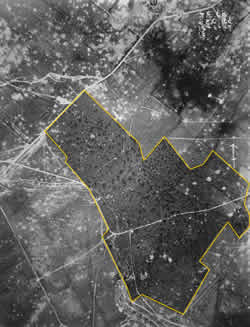
Aerial view of the Hindenberg Line and
Bullecourt, taken in 1920. Two years after
war had ended, the line was still a powerful
defensive position. Credit: Wikipedia
Before proceeding, a brief overview of situation on the ground is needed. By late April 1917, the British Arras offensive had almost run out of steam. On the other side of no man’s land, the Germans had moved to the vicinity of the Hindenburg line, and refused to give more ground. The Hindenburg Line was an impressive constructed network of German defensive fortifications, tunnels, trenches, barbed wire and bunkers. In the north, the Canadians had captured Vimy Ridge overlooking Douai Plain and the German lines. Allied artillery now had observation of enemy movements, trenches, and supply columns for several kilometres. In the centre, the British had launched two separate offensives with very limited results. At the southern flank, the Australians were stuck in pitched struggle at Bullecourt and Lagnicourt.

Happy Canadians who captured Vimy Ridge
returning to rest billets on motor lorries, May 1917
Credit: Library and Archives
On 3 May 1917, the 3rd and final Battle of the Scarpe began. After the war, a British military historian wrote that the first day of combat as “a day which many who witnessed it considered it to be the blackest day of the war.” The British continued their attack in the centre, with minimal results, and the Australians resumed the near suicidal battle of Bullecourt. The Canadian objective on 3 May was to capture a village of Fresnoy, a 1000 yards to east of Arleux.


Map of the Battle of Fresnoy, 3 May 1917.
Credit: Official History of the Canadian
Army in the First Word War: Canadian
 Expeditionary Force 1914-1919, G.W.L. Nicholson
The red-roofed village of Fresnoy was positioned between two wood lands. The 1st Canadian Brigade (Ontario) was assigned the objective. The 2nd Battalion (Eastern Ontario) was to capture the town, and the 1st and 3rd Battalions were to secure the wooded areas located on the sides of the town. The Canadians rehearsed the assault for two days on mock enemy positions, akin to the operational preparation to the attack on Vimy Ridge.

 In the German trenches, soldiers were on a high state of alert after nearly a month of combat. German intelligence sensed another push after witnessing a build-up of troops along the Allied lines. At roughly the time as the British offensive began, the Germans began to shell the British and Canadian lines. A duel between the German and British heavy and medium artillery commenced.

As both sides shelled each other, the signal was given to launch the attack. The Canadian rolling barrage hit Fresnoy at 3:45am, cutting much of the enemy wire. Many Germans from the 25th Reserve Division were forced to seek shelter from the inferno of shells and shrapnel. The artillery pounded and careened into the trench network that surrounded the French village. Following behind the screen of exploding earth and sandbags was the attacking Canadians. In effort to repulse the attack, German machine gun fire raked the approaches to the village; luckily the darkness hid the Canadians as they approached Fresnoy.

Examining a Skull found on a battlefield
of Vimy Ridge. Credit: Library and Archives
Once the Canadians had breached the wire in front of the village, the 3rd Battalion swung south, clearing out the German trenches with enfilading fire. The 3rd Battalion had captured 500 yards beyond their objective (support lines), but in the process they had sustained high losses, losing 1 of their 3 assault companies, roughly 200 men. In the northern sector of the attack, the 1st Battalion quickly overcame the enemy wire, and advanced upon the trenches parallel to the woods known as Fresnoy Park. The 1st Battalion had the easiest task of the 3 units on 3 May, their assigned objective was lightly held and quickly taken.


Canadian writing home from the line, May 1917
Credit: Library and Archives
In the centre of the attack, the 2nd Battalion’s attack was carried out with surgical pin-point accuracy. The three machine gun posts that guarded the town had been silenced within minutes with the use of rifle grenades and covering fire as the assault squads advanced upon the German guns. After cleaning out the trench network, the battalion proceeded to secure the town, neutralizing any remaining resistance that they encountered in buildings. By 6am, the battalion was consolidating their newly won position and digging new defences 250 yards east of Fresnoy.


British Stokes Mortar Crew, 1918.
Once enemy commanders realized the nature of the rupture of their line at Fresnoy, two rapid counter-attacks were ordered. Around 10am, the Canadians received a peppering of high explosive shells on Fresnoy. After the shelling had subsided, units from the German 15th Reserve Division were spotted advancing upon the village from the north east. The enemy counter attack was quickly broken up after the British and Canadian artillery unleashed a torrent of shells and machine gun fire among the attacking infantry. In the early afternoon two more units, the German 4th Guard Division and 185 Infantry Division, were ordered into the fray. The second German attack was able to enter into the Canadian lines, but after the arrival of a stokes mortar crew and a liberal use of grenades, the enemy attack could not advance any further and withdrew.

German Prisoners of War helping a
wounded Canadian, Arleux 1917.
Credit: Library and Archive
As the sun set on 3 May 1917, the Canadians had been involved in nearly 16 hours of strenuous defense and assault. They had lost 1,269 men taking Fresnoy. On the German side, the first day of the 3rd Battle of the Scarpe, official records list their deepest losses occurring at Fresnoy. The loss of Fresnoy did not sit well with the German High Command. One German regimental historian wrote that the Canadians had knocked Fresnoy, “out of the German defensive wall which had to be replaced without delay.” The Allies occupying the town had a commanding sight over sections of German trenches in the Oppy-Méricourt line and the Hindenberg Line (Wotan Stellung).


Canadian identifying a deceased
 German soldier, Arras Sector 1917.
Credit: Library and Archives
 In my next entry, I will look at the second major German attack to re-capture Fresnoy on 8 May 1917 and its impact on the Canadian and British lines.

Tuesday, 1 May 2012

Major Bennett, Peterborough's first war casualty


Credit: Major Bennett Bus, Flickr.com, VB5215


The white and green buses operated by Peterborough Transit are on nearly every major arterial road in the city. The Major Bennett #12 bus is a familiar sight on Aylmer Street and near the newly renovated Lansdowne Place Mall. The commuters that use the Major Bennett route likely haven’t considered the origin of the name. Major Bennett Drive was named after Peterborough’s first casualty of the First World War, Major George Bennett.

Photograph of Major G.W. Bennett,
Credit: Peterborough Examiner, 1915

George Bennett was a prominent resident of the small city of 18,000 people. He was born in 1864 in North Monaghan Township and worked a civil servant for the Government of Ontario. He rose to the prestigious rank of Superintendent of the Department of Public Works overseeing provincial roads in Northern Ontario.  The tall dark haired 49 year old bachelor had served with the local Peterborough militia for over 25 years. After many nights at the Peterborough Armouries on George Street, Bennett received his officer’s commission with the 57th "Peterborough Rangers" Regiment.
Picture of troops in Ypres in June 1915 with bayonets.
Note how the Belgian countryside still had
 trees - not yet mud and siege warfare.
Credit: Wikipedia Commons


When Britain declared war on Germany in August 1914, 115 soldiers from Peterborough’s 57th Regiment rushed to volunteer for overseas service. The eager Peterborough volunteers that were selected for service were to be led by Peterborough’s own Major Bennett. The first batch of Peterborough recruits were assigned to the 1 Company, 2nd Battalion (Eastern Ontario) in the Canadian Expeditionary Force. After months of training in Quebec, and in England, they took their place in the front line against the Germans.


Route of 2nd Battalion on 22 April 1915
Credit: The History of the 2nd Canadian Battalion
(Eastern Ontario Regiment), C.E.F., 1947
At 7pm on 22 April 1915, the Bennett’s battalion witnessed the first use of chlorine gas in warfare. Click here to read about the attack. Bennett and his men were stationed in reserve in rest billets (huts) in the town of Vlameringhe, Belgium. Witnesses from the 2nd Battalion recall watching French troops stagger past the Canadian lines in full retreat; some soldiers “dropping into ditches in convulsions of vomiting.” By 8:30pm, the commander of 3rd Brigade, war hero and holder of the Victoria Cross, Richard Turner was in a complete panic. He ordered immediate assistance to help launch an attack that would get the Germans out of Kitcheners’ Wood. It would take several hours of marching on Belgian roads, stopping intermittently to let ambulances with wounded soldiers pass, before the 2nd Battalion arrived at the designated rendezvous point.

Photograph of the remains of
 Kitcheners' Wood, taken in 1918.
Credit: Great War Forum
Photograph of Kitcheners' Wood,
 June 1917.
Credit: Greatwar.co.uk
At roughly 10 pm, the first two Canadian units attempted to retake Kitcheners’ Wood. Attacking from southerly direction, the 16th Battalion and 10th Battalions made a 200 yard running charge over open ground, facing fire from the chattering German machine guns as they entered into the woods. Within minutes the attack had stalled, the commander of the 10th Battalion lay bleeding to death after receiving 5 bullets to the groin. His men were now engaged in hand-to-hand fighting with Germans in the east, west and in the interior of the wooded area. By the time roll call came next morning, the 16th Battalion only had 193 men out of 813. The 10th Battalion’s casualties were much worse, in a report made three days after the battle; an officer wrote that the unit only has “a small party of men” left.

Location of Kitcheners' Wood and
 Canadian Monument.
Credit: Google Maps
By 1:30am on the morning of 23 April 1915, the 2nd Battalion reported for duty at Mouse Trap Farm. After a quick debriefing of the situation in the woods, it was decided that 2nd Battalion would link up with the units that were already in Kitcheners’ Wood and revive the faltering attack. Three of the four companies of the 2nd Battalion were assigned roles in the attack. No. 3 Company to take the left flank, and No. 2 Company was to swing to the north east (on the right) and link with the men already in the forest and help defend the line.  Following in support was Major Bennett’s No. 1 Company. Bennett’s unit was assigned the task of following the other units (down the middle) of the battalion and act as fire support.
Map of 2nd Battalion Advance. Includes location of No. 1 Coy
attack. Credit: Google Maps

As Major Bennett and his men felt their way forward in the dark, they could see and hear the muzzle flashes and sound of gun fire on their left flank. They knew that their comrades in No. 3 Company needed assistance. After reaching cover of a hill, Bennett ordered a scout to report on the developing situation. After examining the terrain and referencing his position on a map, Major Bennett crawled back to his men. The battalion’s commander, Lt. Col. Watson, approached Bennett’s lagging troops.  Watson bellowed to his subordinate that an attack must be carried out before morning. Major Bennett lay on his stomach on the side of a hill with his men awaiting orders, he may have thought of the irony of being in a farm field similar to his own, only thousands of miles away from North Monaghan. Bennett was told to attack, and as a good soldier he would follow that order.

 As dawn began to break the night sky over Langemarck, Major Bennett prepared to meet his destiny. Bennett put his whistle to his lips, grabbed his service revolver out of the holster, and ordered his men to fix bayonets. After the 15 inch steel blades snapped onto the rifles, the Major stood up and ordered the men to get up. He inhaled.  Waving his arm forward he blew his whistle and charged over the hill.

The German troops in Kitcheners’ Wood saw the soldiers from Peterborough as they descended down the sloping hill. Within seconds, the Germans unleashed a storm of bullets against the Canadians as they ran directly at the German line. As a leader of infantry charge, Major Bennett was one of the first men to be hit. Survivors of the failed attack on Kitcheners’ Wood wrote back to family in Peterborough that Major Bennett was killed instantly when he was hit in the head and stomach with a burst of machine gun fire. Private James Bills of Sherbrooke Street, who was wounded in the charge, wrote back home: “The Canadians did grandly the past few weeks, but our company lost every officer in one day. . . He [Bennett] was loved by all men in the company, and, believe me, they would follow him anywhere.”

             Photograph of George Bennett and No. 1 Company, 2nd Canadian Infantry Battalion.
         The picture taken 3 days before the attack, 19 - 20th April 1915 in Belgium. Major
               Bennett is identified by his crouched stance in the front-centre of the photo.                    
Credit: Personal Collection published in Examiner, May 1915
The 2nd Battalion attack on Kitcheners’ Wood failed. Almost all of the soldiers No. 1 Company were killed or wounded in the charge.  After two days of fighting, the battalion had 494 soldiers at roll call; 540 of the 1,034 men in the unit had died, been wounded or captured. On April 25th 1914, the first news of the battle arrived in Peterborough. Initially, the news reported that the Canadians had succeeded; eventually word came to prepare for large numbers of causalities. On April 28th came the news of Bennett’s death. Letters of condolence poured in from the premier, Prime Minister, and city councillors. In early May a large Anglican memorial service was held in Bennett’s honour. The service included a solemn prayer for all the families in Peterborough that were in mourning or waiting to hear information of their relatives in Ypres. His death represented the war coming to Peterborough. For residents of the city, the Great War was no longer a European side show that they read about in the paper. 

Sunday, 22 April 2012

First Gas Attack, 22 April 1915, Second Battle of Ypres


Credit: Canadian War Museum,
Second Battle of Ypres, 22nd  April to May 1915
 by Richard Jack
Public myth is strongly associated with the Second Battle of Ypres in Canada. Generations of school children have heard of the stories of how the plucky Canadians stood firm during the first use of deadly gas in warfare. When I mentioned that today (22 April) is the anniversary of the gas attack to my wife, she recalls hearing of soldiers running around with urine soaked cloth around their face during the battle. My aim of this article is not to “deconstruct” or ruin the myths and legends of the battle, there are plenty of books that already do that, but rather to tell factually what happened to the Canadians during          the first successful chlorine gas attack.                                                                                                                                                                     

Credit: Library and Archives Canada,
Soldier with Gas Mask, 1917
Before beginning, I want to touch base on the history of use of asphyxiating chemical agents in warfare in the modern age.  The Hague Convention of 1899 and 1907 restricted the use of “poison or poisoned weapons.” All major powers in Europe had agreed to the Hague Conventions including Germany. However, as the war progressed the use of non-lethal gas began to appear in the arsenals of armies on the Western Front.  In October 1914, German artillerymen started to fire teargas artillery shells on French soldiers. French armies replied in kind with smoke and teargas grenades. Eventually the German High Command approved the use of chlorine based on the rationale that the gas would only incapacitate the enemy rather than killing or poison them.

Credit: Library and Archives Canada, 92nd  Battalion,
 Gas Mask Drill, 15 August 1916
The 1914 German war plan called for the immediate capture of Belgium; yet the French and British had held the German army on the outskirts of Ypres. Over 90 percent of Belgium had been captured by Germany, but Britain would not let the last large city in Belgium fall, even if it cost thousands of British soldiers’ lives. In mid April 1915, the Canadians arrived in Ypres and took over the neglected French trenches north east of the city. One officer wrote of the condition of trenches: “trench bottom were just one mass of bodies that were covered over with a far too thin layer of earth, arms, legs, sticking out whenever a rainstorm occurred.” Army engineers wrote in a report, “the ground where the men stand in the firing position is paved with rotting bodies and human excreta.” The defence networks were without shell-proof dugouts, and the trenches were very shallow due to the low water table in the vicinity.  It is obvious that Canadian trenches in Belgian farm fields had much to be desired. 


Troop Dispositions, 22 April 1915.
Credit: Shoestring Soldiers
According to Canadian eye-witness reports, at 5pm (17:00 hours) the Germans began to heavily shell and fire upon the French and British trenches located to the left of the Canadians. The colonial French soldiers from Algeria faced the brunt of the initial gas cloud. Witnesses across the Yser Canal describe seeing a yellowish green cloud creep over the Belgian countryside and hear gun fire get closer. Simultaneously, the Germans opened up their long range heavy artillery, hitting targets around Ypres. French soldiers began to flee, running towards the city of Ypres and choking up the roads leading to the Canadian trenches. One Canadian soldier describes the scene as:

Gas Cloud, 22 April 1915. Credit: Shoestring Soldiers


“A steady tide of humanity – the most mixed and miserable lot of people I had ever seen moved by us in the direction of Ypres, leaving us barely room to squeeze through in the direction of the enemy . . . and of course there were the wounded – hundreds of them – and the main body of French colonial troops in retreat, some of whom had been gassed with yellow faces and gasping for breath.”


Painting Second Battle of Ypres.
 Credit: Canadian War Museum
The  Canadian soldiers that witnessed the destruction of Algerian 45th Division must have felt anxious knowing that they would have to confront the mysterious chlorine cloud. Canadian employed a number of rudimentary tactics to survive the gas attack. Some men simply left their fixed positions, others were told to hold their breath or cover their mouths with cloth. After a few hours of battle, the situation became critical for the Canadians. One battalion, the 13th faced complete encirclement and destruction because of the German breakthrough on their left flank.  The German assault was so rapid that units in reserve several kilometres behind the front line began to fire upon advancing enemy. The Germans had blasted such a large gap in the French line and had advanced so quickly that Canadian artillery guns were able to fire shrapnel shells at point blank range on German infantry that were within 300 metres of gun positions. By the end of the first day of the Battle of Second Ypres, the Canadians soldiers were on the ropes. Several Canadian companies from the 13th Battalion and 15th battalions were isolated, low on ammo, and facing compete destruction. The officers of the 2nd and 3rd Canadian Infantry Brigades were planning a counter attack to retake Kitchener Woods.


Photo of the location of 13th Battalion's
 trenches, now occupied by cattle.
Credit: Matt Ferguson, 2009

It would take two days before Canadians at home heard of the German attack. The initial press reports warned Canadians “to expect many casualties.” In the following weeks, cities and towns across Canada would receive the casualty list of 5,592 of the Canadians that died, went missing, captured or were wounded in the defence of Ypres. Canada would never be the same after Ypres. It was the first time that Canada had collectively lost so many sons. Never before was there so much collective grief and mourning.


Thursday, 19 April 2012

Private William Waterson, DCM, Age 21. “We Loved him . . . He is dear to us . . . In grief we must send to God’s holy will (RIP).”


 Credit: Veterans Affairs Canada,
Virtual War Memorial, 2012

A few weeks ago, the Peterborough Examiner wrote several articles on the story on the local fundraising efforts to repatriate the medals of the late local resident William Waterson. The former Legion president stumbled across an E-bay auction of the medals.  The current owner, based in the United Kingdom, was selling the medals for the pricey sum of over $1000.00. The collection included Distinguished Conduct Medal, Victory Medal, and “Dead Man’s Penny” (a symbolic plaque sent to next of kin after a soldier has died).  What makes Private Waterson’s medal collection unique is the Distinguished Conduct Medal. The DCM medal was awarded to non-commissioned soldiers only upon recommendation from an officer, usually after excellent conduct in the field.

Credit: Library and Archives Canada
William Waterson was a British farm labourer that immigrated to Peterborough Ontario. He arrived in Canada at the age of 16 in 1913. After war was declared, he joined the militia, 57th Regiment Peterborough Rangers on 15 October 1915. He listed his Father, Corporal William Waterson of Royal Defence Corps as his next-of-kin. The Peterborough Recruiting Sargent that stood in front of the baby faced young man with the tiny stature of 5 1/2 feet tall may have reconsidered offering enlistment to the future DCM winner before relenting. Private Waterson's signature on his attestation papers gives an indication of his young age and lack of formal education. After receiving training, Waterson was sent overseas to France as a reinforcement, where he served with distinction in combat with the “Iron Second” 2nd (Eastern Ontario) Battalion. 

The 2nd Battalion was one of most professional Canadian units in the trenches, it was part of the first contingent of 1914 and part of the 1st Canadian Division. Even though Private Waterson was a green reinforcement with no prior combat experience when he arrived at the front line, he must have felt confident that he was in good hands; he fighting along side with seasoned war veterans. Waterson’s officers at both the platoon and company level had witnessed the first gas attack and every Canadian operation since deployment in early 1915.

       Credit: Veterans Affairs Canada,
Virtual War Memorial, 2012

Unfortunately, the 2nd Battalion war diary is scant on information and details. We do know that William Waterson died of wounds, on 10 August 1918. Waterson died fighting in one of Canada’s great military operations of the Great War – the Battle of Amiens.  On the 8 August 1918, the British Empire sent  its shocktroops; the ANZACS (Australians and New Zealanders), Canadian Corps, and 51st (Scottish Highland) Division, into battle. The surprise coordinated attack on the German line was a massive success, over 50,000 Germans were taken as prisoners, and 24,000 were wounded or killed. During the 2nd Battalion assault on Ignaucourt, Beaufort, and Rouvroy-en-Santerre, Waterson was wounded and taken to a casualty clearing station, where he died.

Private William Waterson, DCM is buried Crouy British Cemetery.  He was 21 years old at the time of his death. All Commonwealth Grave tombstones have the option of personalized grave inscriptions by next-of-kin. On Waterson’s grave, it is written, “We Loved him . . . He is dear to us . . . In grief we must send to God’s holy will (RIP).”

- Note: After reviewing Waterson's records, it is interesting to note that he is listed as receiving a wound stripe.